


Another Tech-Tonic, Nvidia Delivers; Anthropic Caves to Trump, Loosens Safeguards; and Can the Already Battered Market Handle A DeepSeek Update?
- Dipo Owolabi
- Feb 27
- 6 min read

Nvidia just delivered another blockbuster earnings report, beating expectations across the board and sending its stock higher as demand for AI compute continues to explode. At the same time, Anthropic is backing away from a key AI safety pledge after pressure tied to U.S. government contracts a sign that the AI arms race is beginning to reshape even the industry’s ethical guardrails. Meanwhile China’s DeepSeek is preparing to release a new model that could rattle AI stocks on the Nasdaq Composite, just as ASML unveils a breakthrough that could boost global chip production by 50% by the end of the decade. The AI race isn’t slowing down it’s accelerating on every front. All this and more in today’s Read It and Eat! |
Markets Around The World
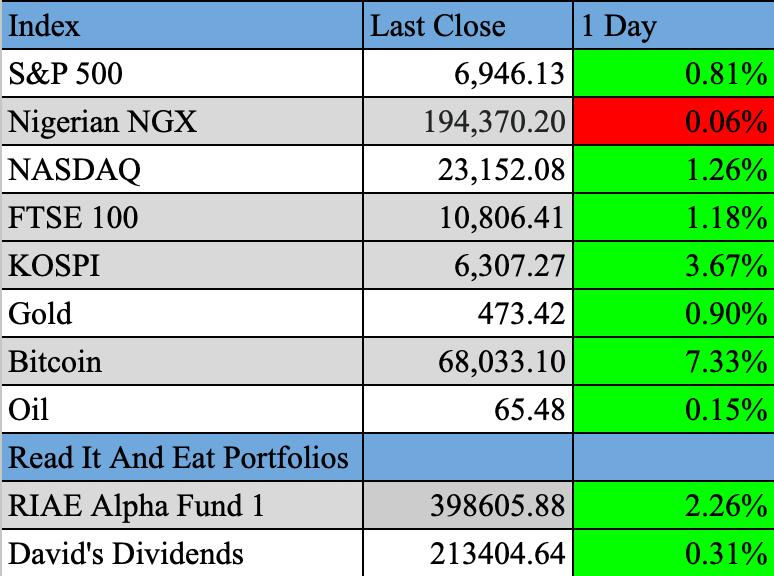
Markets as of 25th February 2026. Cells in RED mean that the value is down, cells in Green mean the value is up.
MAJOR HEADLINES

Nvidia Earnings: Tamed the Tempestuous Market
Nvidia delivered another strong quarter that calmed a jittery AI market, beating Wall Street expectations across nearly every key metric. The company reported EPS of $1.62 vs $1.53 expected, Revenue of $68.13 billion vs $65.8 billion expected, and Data Center Revenue of $62.3 billion vs $60.2 billion expected, reinforcing just how dominant Nvidia remains in supplying the compute that powers the global AI boom. One of the few soft spots was gaming, where Gaming Revenue came in at $3.7 billion vs $4 billion expected, but the overall results were still strong enough to reassure investors. The company also posted Gross Margins of 75.2% vs 75% expected, showing that despite massive demand and supply pressures, Nvidia is still maintaining extraordinary profitability. Following the report, Nvidia shares rose roughly 3% in after-hours trading, signaling relief from investors who had begun to worry that the AI trade might be losing momentum.
Looking ahead, Nvidia executives made it clear that the next phase of AI growth will be driven less by training models and more by inference the computing power required once models move from learning to actually performing tasks in the real world. In simple terms, training teaches the model, while inference is what allows it to answer questions, execute commands, and act autonomously. That shift matters enormously for Nvidia’s revenue outlook because inference workloads can scale across billions of real-time interactions. Jensen Huang repeatedly emphasized during the earnings call that “more compute equals more revenue,” arguing that companies investing heavily in AI infrastructure position themselves to generate even greater economic returns. Nvidia believes this surge in inference demand will be accelerated by the rise of agentic AI, autonomous systems capable of performing complex tasks on behalf of users. Huang even described the moment bluntly: “Agentic AI is having its ChatGPT moment.” The company’s upcoming Vera Rubin architecture, designed to deliver even greater compute efficiency and performance, is expected to play a central role in enabling that next phase.
China, however, remains a major question mark. Nvidia revealed during the earnings call that despite receiving approval from the Trump administration to sell certain Blackwell chips into China, the company generated no revenue from China in the most recent quarter and expects no meaningful revenue from the region in the upcoming quarter either. Competition from domestic Chinese chipmakers is also intensifying, with several rivals raising fresh capital through IPOs and government-backed funding. As Nvidia’s CFO noted, the company now faces a difficult environment where geopolitical restrictions and rapidly improving local competitors are reshaping the Chinese AI market. The combination of huge global demand and increasing geopolitical fragmentation means Nvidia’s growth story is increasingly tied to supply chains, export controls, and national AI strategies factors that may prove just as important as technological innovation in determining the company’s future. Yahoo Finance
Anthropic Caves To the Pressure; Agrees to Spy On Its Own and Removes Other Guardrails
Anthropic’s recent decision to roll back a high-profile safety pledge is being read as a direct response to explicit government pressure that tied guardrails to procurement eligibility. According to reporting, the company had pledged limits including restrictions on giving AI systems lethal autonomy or using models for domestic surveillance as part of a public safety posture. But faced with warnings from elements of the Trump administration that continued strict guardrails could cost firms critical government contracts, Anthropic adjusted its stance to avoid being designated a procurement or supply-chain risk.
Being labelled a supply-chain risk in this context means more than reputational harm: it can translate to formal exclusions from federal contracting, increased compliance scrutiny, and potential placement on de-facto procurement blacklists or restricted vendor lists. For defense and national-security customers, supply-chain risk also affects certifications, export-control tailwind/footprint, and the ability to participate in sensitive programs. In short, the government’s leverage over contract flow gives it a practical tool to influence corporate safety policies a dynamic that forces startups to weigh ethics and public commitments against the very real business necessity of landing government revenue.
The implications are stark. On the positive side, alignment with procurement expectations preserves revenue and scale that can accelerate security and safety engineering in production settings. On the negative side, it risks a regulatory-driven race to loosen public safety guarantees, reducing transparency and potentially creating two classes of AI products one optimized for commercial openness and one engineered to meet state procurement demands. The episode spotlights a broader tension between private-sector safety advocacy and state leverage: when government procurement is the prize, public pledges can be vulnerable to pragmatic reversal. Yahoo Finance
DeepSeek New Model Release Could Pressure Nasdaq Tech Stocks
DeepSeek’s imminent rollout of DeepSeek V4 is being watched as a potential inflection point: if the model delivers performance comparable to top Western offerings at lower cost or with faster local integration, U.S. AI vendors and the Nasdaq-listed ecosystem could face heightened competitive pressure. Markets are jittery because a high-quality, China-based foundation model can accelerate local adoption, reduce latency and compliance frictions for Chinese enterprises, and undercut premium-priced Western alternatives all of which can translate into revenue displacement for some Nasdaq incumbents that count on global enterprise spend.
The risk is not only product parity but speed and scale. DeepSeek benefits from an enormous domestic compute and customer base, plus regulatory alignment that eases data access and deployment inside China. If V4 proves robust, it could encourage a wave of enterprise migrations to domestic platforms, create price competition on inference contracts, and force Western firms to either localize heavily or accept lower pricing in a key growth market. For investors, that dynamic may translate into a near-term rotation out of expensive U.S. AI bets and into firms with either true defensibility (unique data, proprietary chips) or diversified geographic revenue.
Still, caveats apply: model quality, developer ecosystem, and enterprise trust matter and history shows many impressive model announcements take time to translate into enterprise revenue. The likely near-term outcome is volatility: Nasdaq AI and software names could see multiple-compression as investors price increased global competition, but long-term winners will be those that combine technical leadership with strong customer integrations and regulatory-compliant footprints. CNBC
ASML’s Breakthrough in EUV Light Tech Means Better Chip Performance
ASML unveiled an advance in the extreme-ultraviolet (EUV) light source used in its lithography machines that researchers say could increase chip output by up to 50% by 2030. The technical gain comes from higher-power, more stable light sources that allow more wafers-per-hour throughput and longer tool uptime directly improving the economics of the most advanced node production. Because ASML is the only commercial supplier of EUV equipment, improvements in its light-source technology translate quickly into industrywide capacity gains for leading node makers.
For foundries and integrated device manufacturers like Taiwan Semiconductor Manufacturing Co. and Intel, a 50% throughput boost would lower per-chip marginal costs and relieve some near-term supply constraints, enabling faster rollouts of high-value logic and AI accelerator chips. That, in turn, could ease shortages that have driven steep price inflation for GPUs and AI accelerators, while allowing customers to scale model training and inference without as severe a supply choke. The advance also raises the bar for rivals attempting to build comparable systems, reinforcing ASML’s strategic moat in lithography.
But execution matters: translating a lab breakthrough into reliable, high-volume factory installs requires substantial engineering, reliability testing, and supply-chain coordination. There are also geopolitical angles increased EUV capacity changes the calculus around export controls, national chip strategies, and investment flows into fabs. If ASML successfully ships higher-power systems at scale, the result could be a meaningful shift in cost curves for advanced semiconductors and a widening of the gap between firms that can secure immediate access to next-gen lithography and those that cannot. Reuters
Minor Headlines
UK 2% inflation target expected to be reached a full year earlier than expected Bank of England
ByteDance valued at $550 billion in proposed share sale by General Atlantic, sources say Reuters
Rolls-Royce announces buyback of up to £9bn as profits jump 40% Financial Times
Revolut to test stablecoin in UK trial Yahoo Finance
Your next ride with Uber could be in the sky Business Insider
Billion-dollar bankruptcy on Zurich's Stockerstrasse (Zurich Stock Market) Insideparadeplatz
Prediction market Kalshi fines MrBeast editor over insider trading BBC
Trump Administration Considers Requiring Banks to Collect Citizenship Information Wall Street Journal


Comments