


OpenAI Wins In Court But Loses A Cofounder To Anthropic; Google’s Glass V2, Much Better Than V1; Bank CEO Calls Human Capital “Lower-Value”; & Did This Billionaire Kill His Dad?
- Dipo Owolabi
- May 20
- 6 min read

The AI race is escalating far beyond chatbots. Andrej Karpathy has joined Anthropic’s core training team as competition for top AI talent intensifies, while Google is preparing to launch AI-powered smart glasses and build autonomous agents directly into search. In banking, Standard Chartered is openly replacing parts of its workforce with AI to cut costs, signaling how automation is beginning to reshape white-collar jobs. Meanwhile, the son of Mango founder Isak Andic has been released amid ongoing investigations into the billionaire’s fatal fall. All this and more in today’s Read It And Eat! |
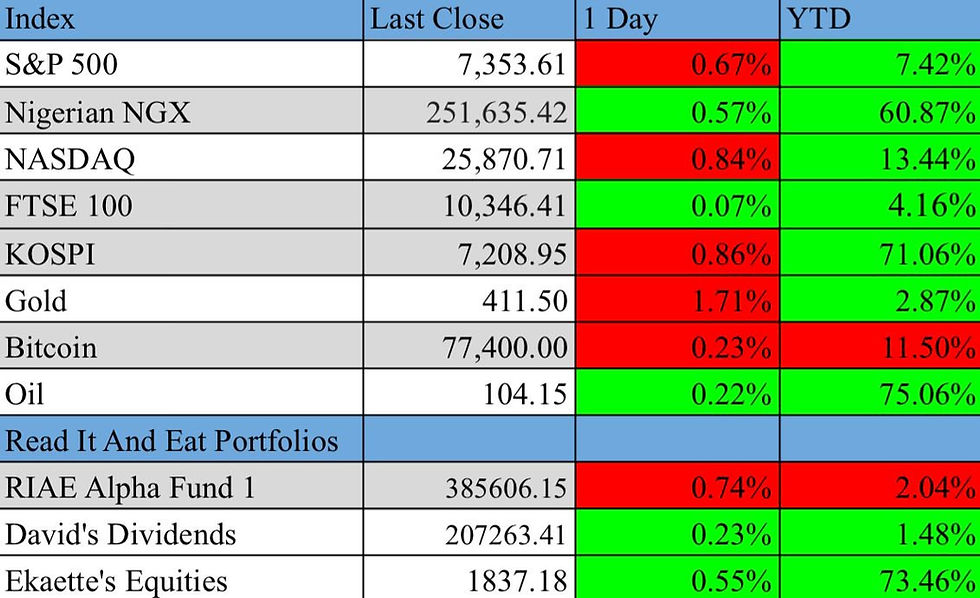
Markets as of 19th May 2026.. Cells in RED mean that the value is down, cells in Green mean the value is up.
MAJOR HEADLINES

OpenAI Co-Founder Andrej Karpathy Joins Anthropic’s Pre-Training Team
Andrej Karpathy, the AI researcher who co-founded OpenAI and previously led AI efforts at Tesla, has joined rival AI company Anthropic. For sports fans, the move is being compared to Cristiano Ronaldo leaving Manchester United to play for Manchester City or like LeBron James suddenly joining the Boston Celtics in the middle of his prime. “I’ve joined Anthropic,” Karpathy posted on X Tuesday. “I think the next few years at the frontier of LLMs will be especially formative. I am very excited to join the team here and get back to R&D.”
Karpathy started this week at Anthropic, where he is working on pre-training under team lead Nick Joseph. Pre-training is responsible for the massive large-scale training runs that give Claude its core knowledge and reasoning abilities, making it one of the most expensive and compute-intensive stages of building frontier AI models. Karpathy is widely regarded as one of the few researchers capable of bridging deep theoretical AI knowledge with large-scale model training execution, making his hire a major signal that Anthropic wants to compete with OpenAI and Google not just through compute power, but through elite research talent and AI-assisted model development strategies.
Before this move, Karpathy spent years at OpenAI working on deep learning and computer vision before departing in 2017 to join Tesla, where he led the company’s Full Self-Driving and Autopilot programs. He later briefly returned to OpenAI in 2023 before leaving again in 2024 to launch Eureka Labs, an AI-focused education startup designed to integrate AI assistants into learning. His move to Anthropic further intensifies the escalating talent war between the world’s top AI labs as companies race to secure the researchers shaping the next generation of frontier AI systems.TechCrunch
After A Decade Plus, Google Re-enters The Smart Glasses Arena
Google is preparing to release a new generation of smart glasses while also integrating more advanced AI “agents” directly into its search engine, according to the Financial Times, as the tech giant accelerates efforts to compete in the rapidly evolving AI race. The company is reportedly betting that wearable devices and AI-powered search experiences will become central to how users interact with the internet in the coming years.
The planned smart glasses would mark Google’s biggest wearable push since the original Google Glass project failed to gain mainstream traction more than a decade ago. Unlike earlier attempts, the new products are expected to heavily integrate generative AI capabilities, allowing users to receive real-time contextual assistance, navigation, translations, and visual search directly through the glasses. At the same time, Google is working to transform traditional search into a more conversational AI-driven experience powered by autonomous digital agents.
The developments underscore how major technology companies are racing to build the next dominant computing platform beyond smartphones. Analysts say AI agents capable of completing tasks, retrieving information, and interacting across apps could fundamentally reshape the economics of online search and advertising, an area Google has long dominated. The push also intensifies competition with rivals including OpenAI, Apple, and Meta as the battle for AI-powered consumer ecosystems accelerates. Financial Times
Dangote is targeting a $50 billion valuation for Dangote Petroleum Refinery & Petrochemicals FZE ahead of a planned stock market listing later this year. BusinessDay says the refinery could sell up to a 10% stake, which would imply an offering of about $5 billion, and a senior Dangote Group executive confirmed that the valuation target matches internal expectations. The project is centered on the 650,000 barrels-per-day refinery in the Lekki Free Zone in Lagos, which has already become Africa’s largest single-train refinery.
That valuation is being anchored by operating scale, not just ambition. BusinessDay reports that the refinery has already changed Nigeria’s downstream fuel dynamics by supplying Premium Motor Spirit, diesel, and aviation fuel at commercial scale, and the business has also expanded into petrochemicals. It is now developing additional industrial projects, including linear alkyl benzene production for detergent manufacturing aimed at Nigerian and African markets.
Standard Chartered is preparing to replace parts of its workforce with artificial intelligence as the bank accelerates efforts to cut costs and improve efficiency, according to the Financial Times. Executives reportedly described certain administrative and repetitive roles as “lower-value human capital,” arguing that AI systems can increasingly handle tasks once carried out by large teams of employees. The move places Standard Chartered among a growing list of global financial institutions aggressively restructuring around generative AI technologies.
The bank is reportedly expanding the use of AI across operations including compliance, customer service, risk management, and internal reporting. Financial institutions globally have been investing heavily in automation tools as advances in generative AI make it possible to reduce manual workloads while processing larger amounts of financial data more quickly. Analysts say banks are now entering a new phase of AI adoption where the focus is shifting from experimentation toward direct workforce restructuring and long-term cost savings.
The remarks, however, triggered immediate backlash from employees, labor advocates, and social media critics who accused the bank of reducing workers to disposable cost items in the pursuit of efficiency. Critics argued that describing employees as “lower-value human capital” exposed a growing corporate mindset in which workers are increasingly viewed as liabilities rather than contributors, especially as AI adoption accelerates across white-collar industries. Others warned that the language reflects deeper fears surrounding the AI boom that companies may use automation not simply to improve productivity, but to justify mass layoffs, leaner workforces, and greater pressure on remaining staff. The controversy has reignited broader debates around whether corporate AI strategies are prioritizing shareholder returns at the expense of long-term job security and workplace morale. Financial Times |
Son Of Billionaire Mango Founder Released But Still Under Investigation For Father’s Death
The son of Mango founder Isak Andic has been released after being detained by Spanish authorities investigating the circumstances surrounding his father’s fatal fall, according to the Financial Times. Authorities had questioned the son as part of an ongoing probe into the incident, which shocked Spain’s business community and triggered widespread media attention due to the Andic family’s prominence in European retail and fashion circles.
Investigators are reportedly continuing to examine the events leading up to the billionaire founder’s death while ruling out several initial theories surrounding the accident. The case has drawn intense public scrutiny because of Mango’s status as one of Europe’s largest fashion retailers and the Andic family’s significant influence within Spain’s business elite. Officials have not publicly disclosed full details surrounding the investigation, though the release suggests authorities may not currently view the son as a primary suspect.
The incident has raised broader questions about succession planning and stability within major privately controlled business empires. Mango, which grew into a global fashion brand under Isak Andic’s leadership, remains one of Spain’s most internationally recognized retail companies. Investors and industry observers are now closely watching how the company navigates leadership uncertainty and reputational risks as investigations surrounding the founder’s death continue. Financial Times
Minor Headlines
|


Comments