


Accenture Beats On AI Demand, Oracle’s Spending Spooks Investors, Adobe Raises Outlook, CarMax Accelerates
- Dipo Owolabi
- Jun 19
- 3 min read

AI remained the biggest theme of earnings season as Accenture beat expectations on resilient demand for cloud and AI consulting services, while Oracle delivered a beat-and-raise but saw shares slide after unveiling massive AI infrastructure spending plans. Adobe also raised guidance as its AI strategy continued attracting new users, and CarMax surprised investors with stronger earnings driven by rising used-car demand and financing activity. All this and more in today’s Read It And Eat Earnings! |
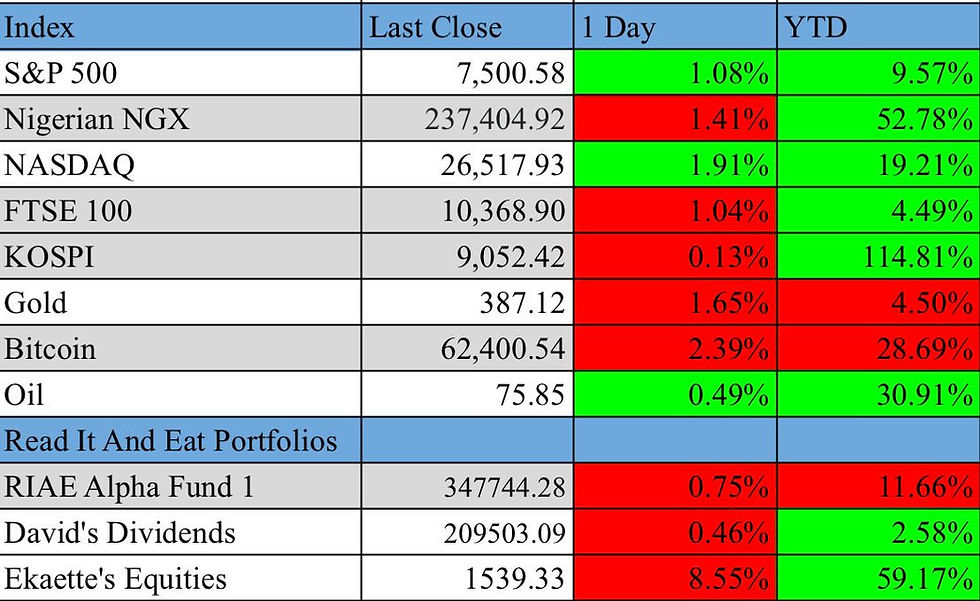
Markets as of 18th of June 2026.. Cells in RED mean that the value is down, cells in Green mean the value is up.
MAJOR HEADLINES

Accenture Beats Earnings As AI And Cloud Demand Remain Resilient
Accenture beat earnings expectations as demand for cloud migration, cybersecurity, and AI consulting services remained strong despite broader concerns about slowing enterprise technology spending, according to Yahoo Finance. The consulting giant continued to benefit from companies seeking help implementing artificial intelligence tools and modernizing digital infrastructure, helping offset softer demand in some traditional consulting segments.
The results reinforce how AI is becoming a major growth driver for professional services firms as businesses race to integrate the technology into their operations. Investors, however, remained focused on future bookings and whether corporate clients may become more cautious with technology spending amid ongoing economic uncertainty. Yahoo.Finance
Oracle Issues Beat-And-Raise But Shares Fall 7% On Massive AI Spending Plans
Oracle delivered a fourth-quarter earnings beat and raised guidance, but its shares fell roughly 7% after management revealed plans to raise an additional $20 billion in equity and $20 billion in debt to help finance its expanding AI infrastructure ambitions, according to CNBC. The company also announced plans to significantly increase capital expenditures as it competes for a larger share of the rapidly growing AI cloud market.
While investors welcomed Oracle's strong operating performance, concerns emerged over the scale of spending required to support its AI strategy. The reaction highlights growing investor scrutiny around whether massive AI investments will generate sufficient returns, even as demand for cloud computing and AI services continues to accelerate. CNBC
Adobe reported a second-quarter beat-and-raise as the software giant increasingly focuses on freemium AI offerings to expand its user base and drive long-term adoption, according to The Wall Street Journal. The company posted stronger-than-expected results as demand remained solid across its creative, marketing, and document software businesses, while AI-powered features continued attracting new users.
Management signaled a shift away from prioritizing short-term annual recurring revenue growth toward using AI tools to broaden customer reach and engagement. Investors are closely watching whether Adobe can successfully convert millions of free AI users into paying subscribers while defending its leadership position in the rapidly evolving AI-powered creative software market. Wall Street Journal |
CarMax Beats Earnings As Used-Car Demand And Financing Activity Accelerate
CarMax beat earnings expectations as improving used-car demand and stronger financing activity helped drive higher vehicle sales, according to CNBC. The used-car retailer reported better-than-expected results as consumers continued turning to pre-owned vehicles amid affordability challenges in the new-car market. The strong quarter also boosted investor confidence, sending CarMax shares higher following the earnings release.
The results suggest that demand in the used-car market remains resilient despite elevated interest rates and broader economic uncertainty. Analysts say CarMax benefited from increased vehicle availability, improved inventory management, and stronger loan origination activity, positioning the company to capitalize on consumers seeking lower-cost alternatives to new vehicles. CNBC
Minor Headlines
|


Comments